
How to Get Court Records
Trousdale County offers no official public portal for trial files. So begin at the counter that keeps the case. The Circuit Court Clerk handles Circuit and Criminal records and takes General Sessions questions. Chancery matters go to the Clerk & Master. That office covers equity, probate, domestic-relations, and related civil files. Not sure which division fits? Phone or email first. Staff can confirm the case number, tell you whether the file is public, explain copy methods, and point you to another office if they do not hold the record.
- Identify the court, case number, party name, date range, and exact document.
- Call or visit the proper clerk, or ask whether mail, fax, or email is accepted.
- Use the county form for a defined county-held copy or inspection request.
- Ask for inspection, a plain copy, or a certified copy and request an estimate.
- Pay by the confirmed method, then arrange pickup, mail, or electronic delivery.
The Public Records Request Coordinator routes county requests but cannot override court-clerk custody rules. Tennessee runs no verified statewide portal for Trousdale County trial files. The AOC Public Case History site covers appeals only. For a starting index, try the local Trousdale County case search routes.
Trousdale Court Records Have Two Clerks
Asking vaguely for "the civil file" can land you at the wrong counter. Trousdale County splits its court records between two offices. Circuit Court Clerk Kim Taylor handles Circuit and Criminal records and serves as the practical first stop for General Sessions. Clerk & Master Shelly Brawner keeps the Chancery records. Both work inside the County Justice Center. They occupy separate suites, though, and each maintains different case groups. The Tennessee AOC court-clerk directory lists Kim Taylor's official Trousdale County Circuit Court Clerk entry.
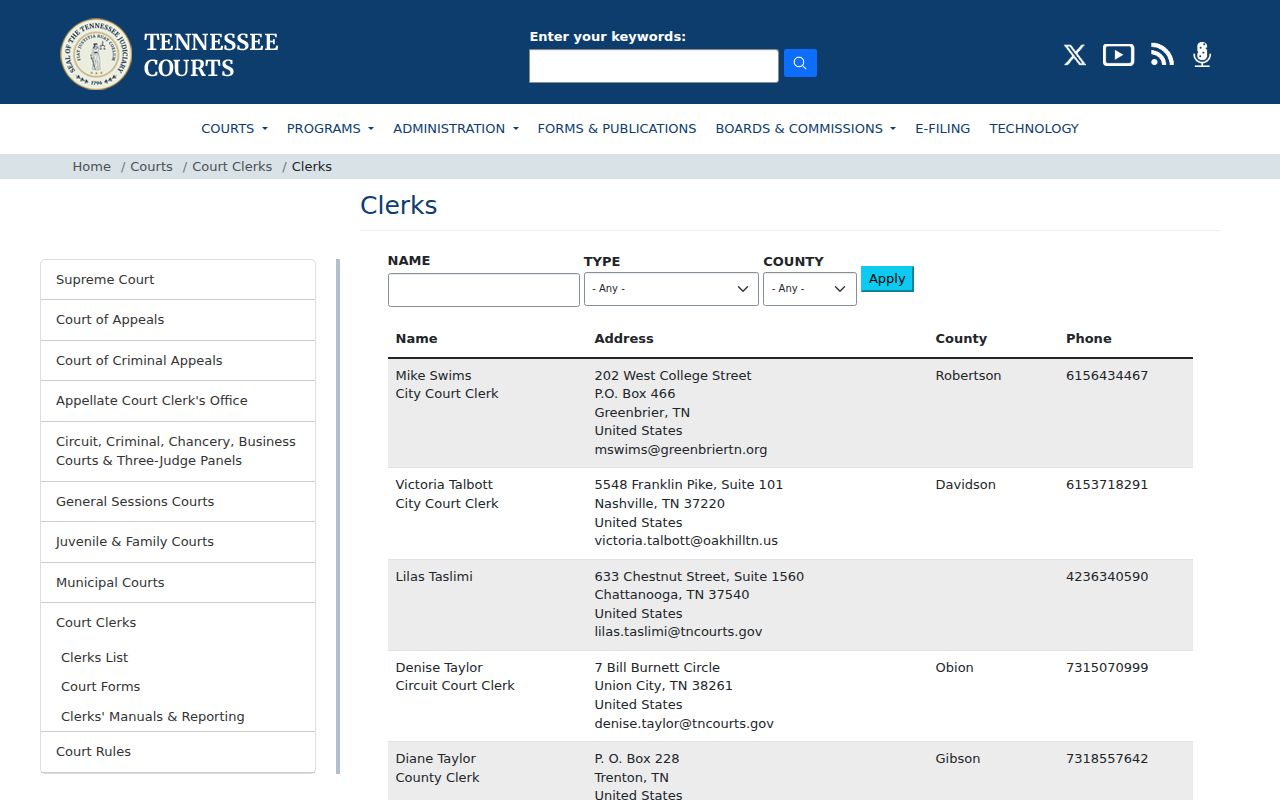
That state directory confirms the Circuit Court Clerk contact. Chancery court records stay with the locally listed Clerk & Master.
Types of Court Records
Think of the docket as a chronological index. The court record is the file behind it. A request can target one entry or document rather than a whole file. What becomes public depends on the case type, any sealing order, redaction rules, and whether the office keeps the item at all.
- Docket sheets, complaints, petitions, answers, motions, notices, and briefs
- Summonses, returns, warrants, indictments, citations, orders, and judgments
- Sentencing papers, decrees, probation filings, and appellate notices
- Public exhibits, maps, photographs, transcripts, recordings, and bond records
- Payment ledgers, minute books, microfilm, and certified copies
Transcripts, recordings, and exhibits may follow a different copy process. A public docket line does not mean its attachment is open. Where a file might hold protected data, ask for the "public, nonsealed version." If something cannot be released, ask whether a redacted copy exists. Also ask which rule controls the restriction.
Trousdale Court Record Request Details
The county form asks whether you want inspection, copies, or both. It also seeks the record type, timeframe, subject, and keywords. Use those fields to name the court division and the document. A subject line like "Trousdale County General Sessions public docket entries and disposition" works well. Follow it with a citation or case number and a short date range.
Inspection-only requests may be oral under county policy. No one can force them into writing. Copy requests go through the written form or an equivalent. The policy's statutory process requires proof of Tennessee citizenship. Immediate action is not always practical. When it is not, the county sends a written response within seven business days. That response may produce records, estimate costs, or route the request. It may also explain a denial, or say why more time is needed. The Trousdale County Archives page explains the county repository. It also shows how the public reaches records transferred out of active offices.
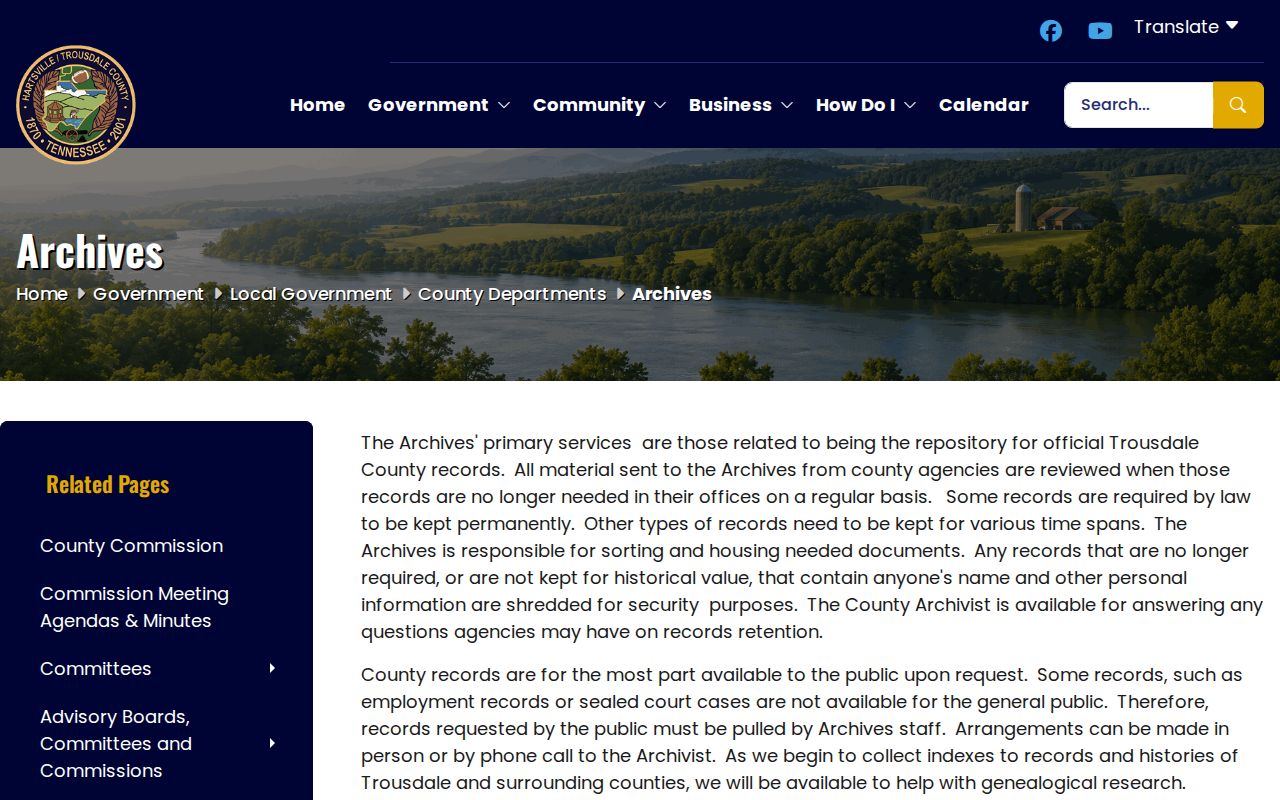
The archive route suits older court records best. Current files should still begin with the right clerk.
What a Court Record Contains
A Trousdale County court record can pair an identifying docket with pleadings, rulings, and later enforcement or appeal papers. Read each field in context. A filed motion is only a request. It is not proof the judge granted it. A service return shows notice activity; an order records a judicial act.
| Case Number | The local identifier carried through later filings; confirm its format with the clerk. |
|---|---|
| Caption and Division | Public case title and the Circuit, Criminal, Chancery, or General Sessions court. |
| Pleadings | Complaints, petitions, answers, motions, notices, and file-stamped dates. |
| Orders and Judgments | Rulings, dispositions, sentences, decrees, or corrected orders. |
| Docket Sheet | A dated index of filings and settings, not always document images. |
| Exhibits and Media | Filed evidence or recordings, subject to separate access limits. |
Financial entries may list costs, fines, payments, or balances. A summary is not always the full ledger. An appeal can add a second case number, so keep both local and appellate numbers. Each points to a distinct record system.
Historic Trousdale Court Record Trail
Older records may have left the active clerk's file room. Trousdale County Archives receives official records once operating offices no longer need them. Transfer remains subject to retention rules. The Tennessee State Library and Archives catalog lists Trousdale Circuit Court minutes from March 1906 through 1973. It also lists later civil and criminal minute volumes into the 1990s. Those books can document court action. They help when no modern electronic result exists.
When you ask, give an approximate year, the court, a party name, and the entry type. Ask whether the material remains local. It may have moved to county archives, or sit on a TSLA microfilm roll. Minute books are not a live docket. Historic custody does not lift restrictions on sealed cases. Treat the archive route as a chain of referrals. Do not treat it as a sweep for every mention of a surname.
Certified Copies and Fees
A plain copy just reproduces the public record. A certified copy bears the clerk's authentication. Ask which version the receiving office needs. Trousdale County policy publishes general copy rates but does not set every court certification charge. For certification or court-specific service, the clerk should give an itemized estimate.
| Item | Amount |
|---|---|
| Black-and-white letter/legal page | $0.25 per page |
| Color letter/legal page | $0.50 per page |
| Letter, legal, or ledger scan | $0.10 per scan |
| Existing electronic document by email | No charge under county policy |
| CD/DVD or flash drive | $5 or $10, plus labor |
| Court certification | Ask the clerk |
You can look at records for free. If staff time runs past the first hour, though, the county may bill for that labor. Copies on other media, vendor charges, and postage are passed along at actual cost. Bring cash or a cashier's check. The county does not take personal checks. Be ready to pay in advance if asked.
Trousdale County Circuit Court Clerk
303 E. Main Street, Suite 2
Hartsville, TN 37074
615-374-3411
Trousdale General Sessions Record Route
General Sessions in Trousdale County is a limited-jurisdiction court. Its criminal docket covers preliminary hearings, misdemeanors, traffic matters, and ordinance cases. That structure is consolidated at the county level. The old Hartsville Municipal Court now sits as an extra General Sessions division. So if you find a record with a city label, don't hunt for a separate modern Hartsville municipal clerk. There isn't one to receive it. The Tennessee AOC courthouse directory lists a shared location. Trousdale County Circuit, Criminal, and Chancery courts all use it.
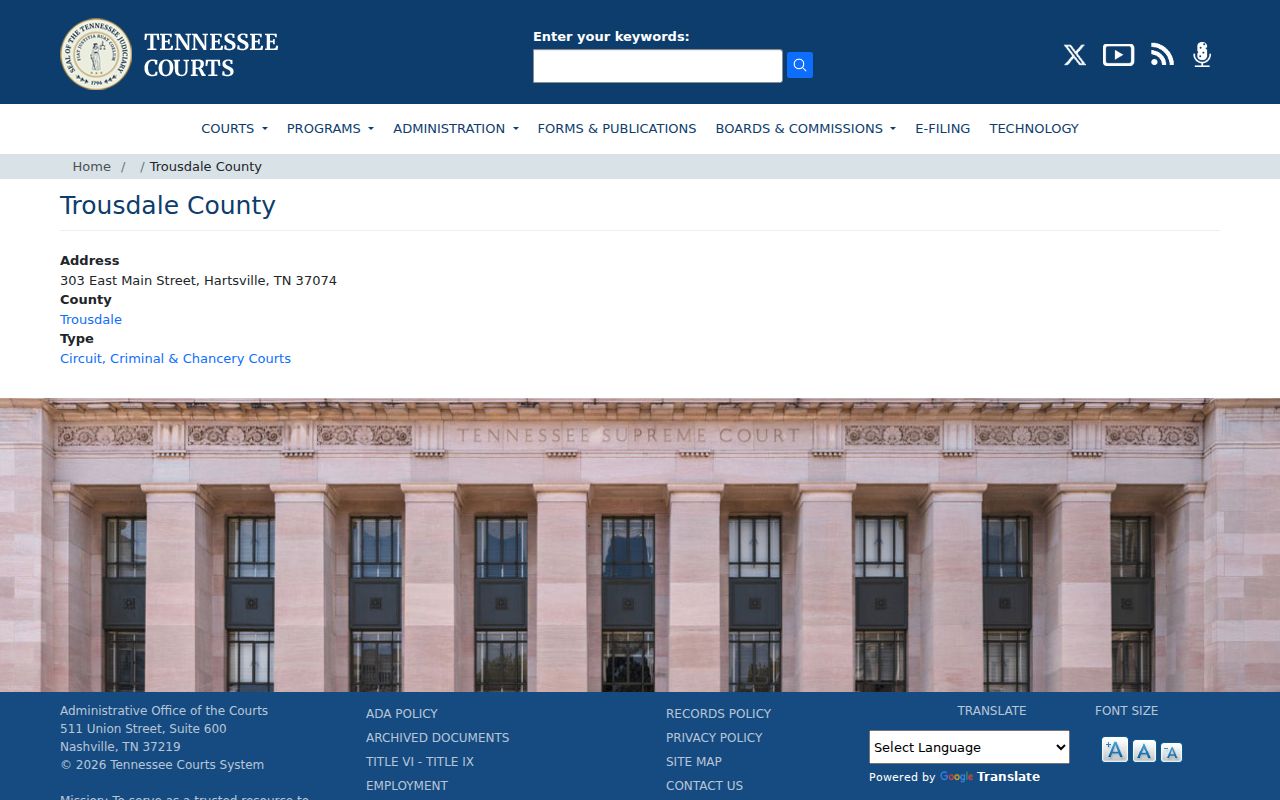
That directory entry points you to the Justice Center, but it offers no searchable docket. To get a case lookup done, contact the Circuit Court Clerk. Bring a case or citation number, a public party name, and a date. Tennessee confidentiality rules matter here too. They can close or restrict juvenile records. That can happen even where an adult General Sessions file would stay open.
Public Access and Sealed Records
Tennessee law leans toward public access to court records. Even so, a docket entry and the documents filed behind it are not always open to the same degree. A seal, a protective order, a statute, a rule, or a redaction duty can hold part of a file back. Social Security numbers, account data, protected addresses, medical facts, victim information, and juvenile identifiers are the types of details that get removed.
Key Rules:
Tennessee Supreme Court Rule 34 defines public court records and confidential, sealed, internal, and protected categories.
Tennessee Juvenile Rule 114 protects dependent and neglect cases and permits closure of some delinquent or unruly proceedings.
T.C.A. § 10-7-503 guidance explains the Tennessee Public Records Act framework.
Expungement starts in the court where the case began. It can pull a record out of ordinary public view at the courthouse. Keep in mind that a missing result does not prove no case ever existed. If a request is denied, ask the clerk why. Ask too whether a public redacted version can be produced instead.
Trousdale Court Record Delivery Choices
Trousdale County allows several delivery routes for records. You can pick copies up in person. You can get them by mail after paying postage. Existing electronic records can come by email, or you can arrange another method with the clerk. Practices vary, though, for certified documents, large files, and redacted material. Before you send any money, confirm what's required. Identification, a signed form, prepayment, or a self-addressed envelope may be needed.
Here's a wrinkle worth catching. The county policy directs records requests to the County Mayor's Office at 328 Broadway, Room 6. The county's own form names Room 10 instead. Calling the Public Records Request Coordinator at 615-374-2461 settles that conflict fast. Remember that court clerks work from the Justice Center, not the Broadway office. Getting the routing right keeps your request with its lawful custodian and saves you delay.